Yazar: Muhammed Baki Sümer

  • Optimizing Data Center Cooling with Compressors

    Optimizing Data Center Cooling with Compressors

    Today, I want to talk a bit about compressor types used in data center cooling systems and how the differences between them can affect overall design. It’s also important to understand which compressor type fits best with which kind of system layout or capacity.

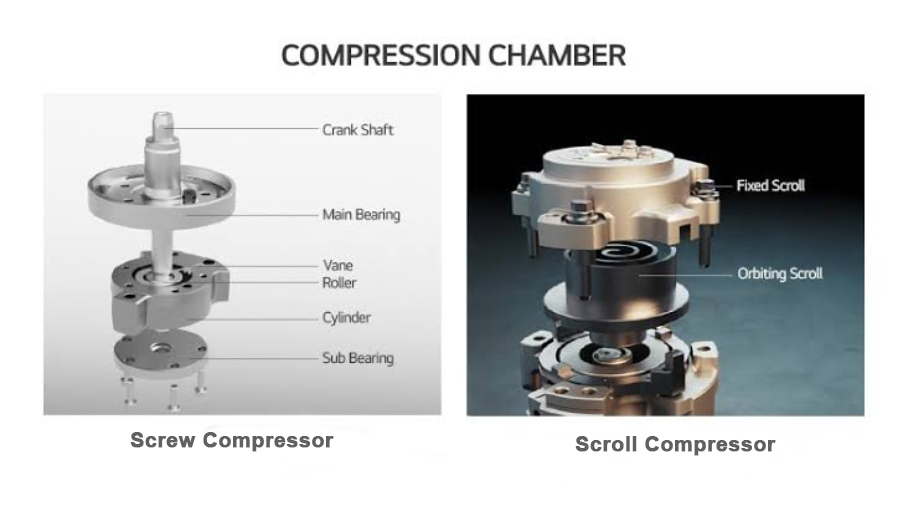
    Let’s start by understanding how these compressors actually work. Scroll compressors operate using two spiral-shaped scrolls—one fixed and one that moves in an orbiting motion. This design compresses the refrigerant in a smooth and quiet way. Because of their simple and compact structure, they are often used in smaller systems or modular solutions.

    Screw compressors work differently. They use two interlocking helical screws to compress the refrigerant in a continuous, smooth flow. This type of compressor is more suitable for higher loads and is commonly found in industrial HVAC systems and large-scale chillers. The operation is stable, reliable, and much more efficient when the cooling demand is high.

    As I mentioned, the most efficient compressor depends on the system design. For example, if your data center has relatively low capacity, scroll compressors are usually a better fit. They perform better under partial loads and can handle frequent start-stop cycles without issues. So if the cooling system is expected to turn on and off often or run at variable loads, scroll compressors offer a solid, efficient choice.

    However, if you’re designing a high-capacity data center, the better option is definitely the screw compressor. In fact, it’s quite rare to find a high-capacity chiller that uses scroll compressors—most of them come equipped with screw compressors by default. That’s because the design and working principles of screw compressors are better suited to high cooling loads.

    From my experience, I’ve seen cases where end users chose in-row or large quantities of DX in-room cooling systems with scroll compressors for high-capacity data centers. This kind of decision often leads to problems later. I’ll go into more detail on that topic in another post, but to stay focused here: in-row and DX in-room units typically use scroll compressors, and they are really only intended for small or medium-scale environments. When used in larger systems, they can cause multiple issues—like service disruptions, lower energy efficiency, and poor cooling performance overall.

    Luckily, this kind of mismatch doesn’t happen very often in professional data center projects. In most large-scale setups, the cooling system is based on chilled water chillers that use screw compressors. These compressors offer more stable operation thanks to their continuous compression cycle rather than a pulse-based approach. This leads to greater efficiency, especially when cooling demand is high.

    When screw compressors are combined with variable speed drive (VSD) systems, energy consumption is optimized even further. They adjust their speed according to the system’s needs, which reduces wasted energy and improves performance per ton of cooling.

    Of course, there’s always an exception. In systems where frequent start-stop cycles are required—like smaller data centers or modular edge setups—scroll compressors might actually be more efficient. Their ability to handle cycling without losing performance makes them a valuable option in those cases. modular edge setups—scroll compressors might actually be more efficient. Their ability to handle cycling without losing performance makes them a valuable option in those cases.

    I will reach out to another design points in my upcoming blog posts. Wishing you a smooth path ahead—may everything in your life run as smoothly and beautifully as a well-designed data center. Here’s to success and happiness!
  • The Golden Guide to Data Center Design and Operations: Why ASHRAE Matters

    The Golden Guide to Data Center Design and Operations: Why ASHRAE Matters

    Hello,

    Today, I want to talk about ASHRAE and why it is important for data center design. First of all, ASHRAE (the American Society of Heating, Refrigerating and Air-Conditioning Engineers), as you can understand from the name, is an essential authority on cooling analysis for data centers. This standard (ASHRAE TC 9.9) defines the ideal cooling conditions for IT equipment. ASHRAE includes the A1, A2, A3, and A4 classifications, which specify recommended operating temperature and humidity ranges. Another important aspect covered by ASHRAE is dew point management.

    ASHRAE is not widely known by the general public when it comes to data center design and operation. However, ASHRAE directly affects your PUE and overall efficiency. According to ASHRAE, your IT equipment’s inlet air temperature should be maintained between 18 and 27 °C. This is a wide range, and system efficiency is directly related to discharge air temperatures.

    If I design based on 18 °C, it keeps the system safe, but it is not efficient. However, if I design for 27 °C, it means achieving the best cooling efficiency and lower energy consumption. Depending on your choice, your system could be up to 35% more efficient.

    What is the impact on the cooling system? Actually, higher discharge air temperatures mean:

    • Lower chiller compressor consumption
    • Lower in-room unit fan speeds
    • Reduced dehumidification requirements
    • Longer free cooling periods

    These features directly improve the overall system efficiency. And efficiency also means sustainability. With this approach, you are essentially determining the system efficiency during the design phase. This is only one of many design considerations for data centers, but it is one of the most important ones.

    I will reach out to another design points in my upcoming blog posts. Wishing you a smooth path ahead—may everything in your life run as smoothly and beautifully as a well-designed data center. Here’s to success and happiness!

  • Battery Energy Storage Systems: The Future Backbone of Sustainable Data Centers

    Battery Energy Storage Systems: The Future Backbone of Sustainable Data Centers

    Hello,

    In recent days, we’ve been discussing BESS (Battery Energy Storage Systems) more frequently, but what exactly is it, and what role does it play in data centers?

    Many people confuse BESS with UPS systems in data centers. While they may appear similar at first glance, they serve very different purposes. BESS is designed to be integrated with renewable energy sources such as solar, wind, or other green supply systems. However, it can also be connected to the utility grid. The main role of BESS is to store excess energy generated by renewable sources during periods of production, and then supply this energy when those sources are unavailable—such as at night or during outages.

    Because of this capability, BESS has the potential to reduce or even replace the reliance on traditional generator (genset) systems in data centers. Although BESS may seem similar to UPS due to shared components like batteries and inverters, their purposes are fundamentally different.

    UPS systems, on the other hand, provide instantaneous power transfer, typically within milliseconds. When a power outage or fluctuation occurs, the UPS immediately takes over to ensure continuous power to critical equipment. This switchover typically occurs within 0–10 milliseconds, preventing any data loss or hardware damage.

    Additionally, UPS systems filter out electrical noise and harmonics, thereby protecting sensitive electronics and improving overall power quality.

    In contrast, BESS is primarily focused on energy storage and load management, so functions like instantaneous transfer and harmonic filtering are not its main strengths.In addition to backup power, modern BESS solutions also provide advanced functionalities such as peak shaving, load shifting, frequency regulation, and other grid services. These capabilities make BESS a dynamic component in energy-efficient and resilient data center power architectures.

    Moreover, while BESS can provide longer backup durations, UPS systems are usually designed for short-term backup—typically around 10–15 minutes—just enough time to allow generators or alternative systems to start up.

    When we consider sustainable infrastructure design in data centers—especially as more facilities are now powered directly by solar PV, wind, or hybrid systems that combine renewables with the grid—the environmental impact of diesel or gas generators becomes a major concern.

    Generators contribute to carbon emissions, air pollution, and noise, all of which negatively affect a data center’s sustainability profile. They also involve higher operational and maintenance costs due to fuel consumption and regular servicing needs.

    For these reasons, reducing reliance on generator systems is becoming a technical and environmental priority. Integrating solutions like BESS, advanced power management platforms, and demand response mechanisms can improve sustainability, reduce emissions, lower operating costs, and enhance reliability—while also helping data centers comply with green standards and environmental regulations.

    In Today’s post, I wanted to write this technical paper to help prevent confusion between BESS and UPS systems in data centers. I hope this paper finds you well.

    Wishing you a smooth journey—may everything in your life run as smoothly and efficiently as a well-designed data center. Here’s to success and happiness!

  • Have you ever heard of Tier 5?

    Have you ever heard of Tier 5?

    Hello,

    Let’s take a look at the biggest data center in the world today. If you have any comments or additional information, please feel free to share your thoughts in the comments section.

    Yes, you heard that right. I’m talking about Tier 5. Of course, this is not an official classification by Uptime Institute. Instead, it’s a slogan used by Switch Data Center Campus. Let’s explore together why they refer to their data center system as Tier 5.

    Technically, their data center meets the criteria for Tier 4, but Switch uses the term “Tier 5” as a premium quality designation to highlight their enhanced infrastructure security, commitment to green energy, and comprehensive redundancy strategy.

    Their total capacity is 650 MW, and each rack supports more than 55 kW of power. The campus covers nearly 7 million gross sq FT and is powered by solar, wind, and geothermal energy sources. The data center consists of independently operated modules that do not affect each other in case of failure.

    They have on-site fire and security teams, making it feel like a small city. Each cooling infrastructure system is fully separated, just like all other critical infrastructures. Encapsulated structures are used to isolate equipment from fire, flooding, and other disasters.

    Not only power and cooling but also physical security, cabling, and network infrastructure are all fully redundant. A 10-layer physical security system is in place, including biometrics, armed security, and zoned access control. The facility has also been recognized by Greenpeace as the most environmentally friendly data center in the world.

    In today’s post, I wanted to share my thoughts on Switch’s data center infrastructure and design approach, which caught my attention. If you would like to learn more, feel free to visit their website.

    Wishing you a smooth journey—may everything in your life run as smoothly and efficiently as a well-designed data center. Here’s to success and happiness!

  • Electricity Demand in Data Centers: Current Trends and Future Expectations

    Electricity Demand in Data Centers: Current Trends and Future Expectations

    Hello,

    Today, I’d like to talk about the electricity demand in data centers and the future expectations surrounding this topic. What is driving this trend? What are the forecasts?

    First of all, as we all know, the world has limited energy resources, and we must use every energy parameter more efficiently. According to the IEA (International Energy Agency) analysis, total data center electricity consumption is approximately 415 TWh (terawatt-hours) in 2024, which represents around 1.5% of global electricity consumption. Over the past five years, this figure has been growing at a rate of 12% annually.

    The expectation is that by 2030, electricity consumption by data centers will reach around 945 TWh, accounting for about 3% of global electricity consumption. Based on these analyses, a 100% increase is expected over the next five years, clearly indicating that the demand and need for data centers will continue to grow significantly.

    But what’s driving this growth?

    The primary reason is the rise of AI and advanced IT technologies. According to IEA projections, with the rapid adoption of AI applications, the electricity consumption of accelerated servers is expected to grow by 30% annually. These servers alone are projected to account for around 50% of the total increase in data center electricity consumption between 2024 and 2030.

    Of course, these conditions will create new challenges—both in terms of infrastructure capacity and general system requirements. In my upcoming blog posts, I will aim to explain the latest technologies, the characteristics of AI-driven workloads, and how these trends are expected to impact data center infrastructure.

    When we consider that the United States and China are responsible for nearly 80% of global electricity consumption in data centers (with the U.S. at 240 TWh and China at 175 TWh), it becomes clear why modern data center design and equipment technologies are more critical than ever.

    What awaits us in the future? How can we prepare starting today?

    I will reach out to them in my upcoming blog posts. Wishing you a smooth path ahead—may everything in your life run as smoothly and beautifully as a well-designed data center. Here’s to success and happiness!g posts. Wishing you a smooth path ahead—may everything in your life run as smoothly and beautifully as a well-designed data center. Here’s to success and happiness!

  • What Does Sustainability Mean for Data Centers?

    What Does Sustainability Mean for Data Centers?

    What is the Data Center’s Role in Our Lives? What is Sustainability? What is Its Effect on Data Center Systems? How Can We Achieve It in the Data Center Ecosystem?

    It’s no secret that data centers power our digital lives. From streaming your favorite show to managing critical business applications, they’re the unsung heroes working behind the scenes 24/7. But as the demand for data grows, so does the responsibility to make these centers more sustainable. After all, meeting today’s needs shouldn’t mean sacrificing tomorrow’s resources.

    What Does Sustainability Really Mean?

    At its core, sustainability means not borrowing from the future to solve today’s problems. When it comes to data centers, this idea becomes a challenge — but also an opportunity. It means designing and running data centers that use resources wisely, minimize waste, and prepare for future demands. So, how can we provide this in data center design and operation?

    It’s quite simple. First of all, we know that energy supply is limited and must be used more efficiently. The first step: if we want our data centers today to meet future requirements, we must ensure they operate efficiently. This relates to electrical and mechanical infrastructure systems. In addition to infrastructure, your management must be efficient. That means having predictable management features. As we say, “We can’t manage what we can’t see.” With this approach, sustainability essentially means enabling systems to communicate with each other, making them visible and manageable, and equipping the infrastructure with the most efficient and cutting-edge technologies.

    Secondly, after establishing the infrastructure, your data center should support future requirements. This means your data center should be open to expansion. Your system must be able to respond to future needs, both in design and footprint.

    Besides these points, we should consider many different standards and regulations (ASHRAE, Uptime Institute, BICSI, ISO, LEED Certification, etc.).