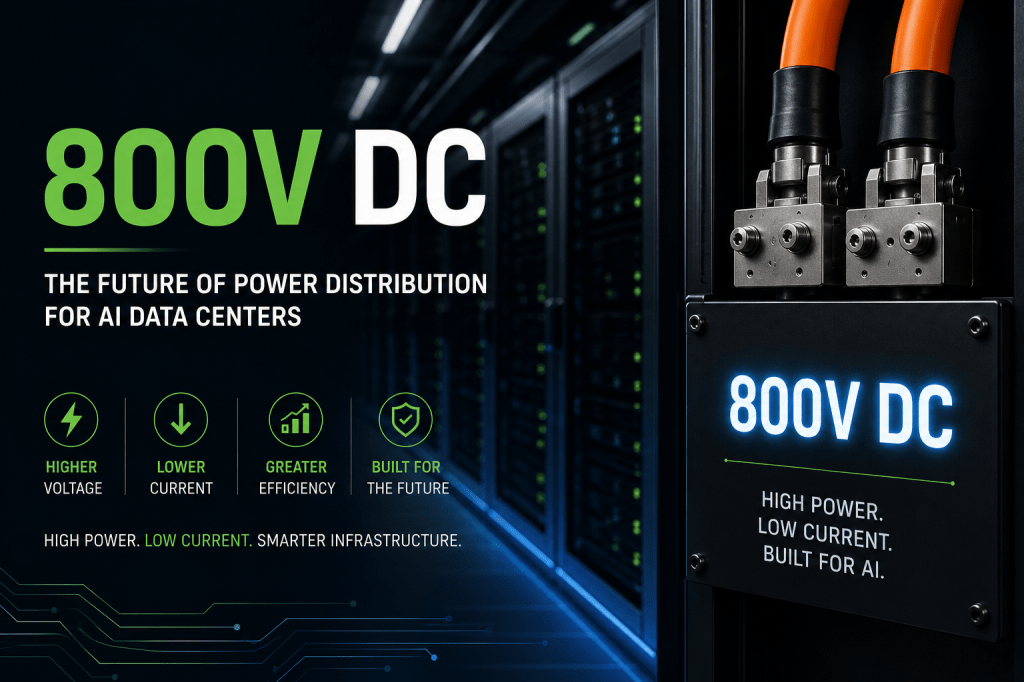
Today, we will take a closer look at the 800V DC concept, which we have started hearing more frequently in recent times and which is rapidly becoming part of our lives, as well as the design principles behind it.
Why do we need 800V DC? How does 800V DC add value to data centers? What are its benefits to the system, and what are its risks? We will try to answer all of these questions.
In terms of AI load characteristics, GPUs are essentially DC-powered, with low-voltage DC levels being used within the power electronics architecture. Today, 12V and particularly 48–54V DC are used as low-voltage rack-level distribution levels. With the NVIDIA GB200 and GB300 platforms, rack-level power requirements have increased significantly. Although 48–54V DC can support rack power levels in the hundreds of kilowatts, as rack power density increases, distribution current, copper requirements, busbar volume, and I²R losses are becoming significant design constraints.
So, what happens when we move beyond these levels in high-density AI racks?
Yes, this is exactly where we are now discussing 800V DC architectures designed to address rack-level power requirements of 400 kW and above in a more efficient and scalable way.
800V DC not only provides a more compact solution for high-capacity power requirements, but also makes the system more efficient and scalable. The fundamental principle is actually quite simple: increase the voltage while keeping the power constant in order to reduce the current.
This enables us to reduce copper requirements and I²R losses, optimize busbar and cable cross-sections and volumes, deliver higher power per rack, and make the power distribution system easier to scale.
For example, let’s consider a 1 MW rack:
At 54V DC: approximately 18,519 A
At 800V DC: 1,250 A
Therefore, by increasing the voltage while maintaining the same power, we can reduce the current by approximately 15 times.
The purpose of 800V DC is not to operate the GPU directly at 800V DC. GPUs continue to operate at much lower DC voltage levels required by their power electronics and semiconductor architecture. Instead, 800V DC is used as a power distribution voltage to deliver high power to AI racks at significantly lower current levels.
So, another question naturally arises: why 800V? Why not 1,000V?
What is the secret behind 800V, or, to put it in a slightly humorous way, what stopped us at 800V? 🙂
800V is not simply a solution designed to reduce current. It represents an engineering optimum in which multiple parameters are considered together, including insulation, safety, component availability, DC fault interruption, and DC/DC conversion ratio.
As voltage increases, current decreases; however, insulation requirements increase, clearance and creepage distances increase, DC fault interruption becomes more complex, extinguishing DC arcs becomes more challenging, DC breaker design becomes more demanding, and switchgear and protection requirements increase.
Therefore, rather than simply using the highest possible voltage, it is more accurate to consider 800V DC as a balanced engineering solution between high power density, efficiency, safety, insulation requirements, protection, and overall system cost.
After talking about all these benefits and added value, does this system have any risks?
Of course, it does.
One of the key challenges is that DC systems do not have a natural zero-crossing point, which means that an arc generated during a fault or switching event can be more difficult to extinguish than in AC systems. Therefore, the protective measures implemented in the system are also critical.
Busbar connection points, DC breakers, cable terminations, rack connections, disconnect switches, and connectors are all critical points that require careful consideration.
So, how can we manage these risks?
In fact, with the right design principles, these risks can be effectively controlled.
Using DC-rated circuit breakers, appropriate DC fuses, Arc Fault Detection, Fast Fault Detection, Solid-State Protection, Insulation Monitoring, Ground Fault Detection, thermal monitoring systems, and periodic torque checks, together with selectivity / protection coordination studies, are all critical.
In addition, during the design phase, it is essential to use engineering software such as ETAP to perform Load Flow, Short Circuit, Protection Coordination, and Arc Flash analyses, and to simulate how the system will behave under different fault scenarios.
Therefore, I am confident that 800V DC will become increasingly present in our lives in the coming years, and that we will soon be discussing power densities and capacity levels in data centers that we are not even considering today.
Especially with the arrival of Vera Rubin and subsequent generations of AI platforms, rack-level power requirements in data centers will move to completely different levels. Therefore, preparing our infrastructure for the transition to 800V DC today is becoming an increasingly important consideration.
I will reach out to another design points in my upcoming blog posts. Wishing you a smooth path ahead—may everything in your life run as smoothly and beautifully as a well-designed data center. Here’s to success and happiness!


Bir Cevap Yazın